Brazil · Visited August 2026 · 2 weeks
Rio de Janeiro for Digital Nomads
A huge, beautiful city squeezed between granite peaks and the Atlantic, with a beach culture like nowhere else.
Great for staying active · Beach on the doorstep
By James, founder of Nomad Register · Updated November 2026



Rio de Janeiro at a glance
- Overall
- 7/10
- Work setup
- 8/10
- Walkability
- 7/10
- Value
- 6/10
- Safety
- 5/10
- Lifestyle
- 9/10
- Living costs
- About R$5,000 a month before rent
- Tourist stay
- 90 days for most visitors, with an e-visa needed for US, Canadian and Australian citizens
- Nomad visa
- Available: up to 2 years
- Time zone
- BRT (UTC−3) all year, no clock changes
- Currency
- Brazilian real (R$)
- Internet
- Fibre is widespread, with 100Mbps+ typical
- Airports
- GIG (Galeão, international) and SDU (Santos Dumont, mainly domestic)
- Population
- About 6.2 million (city), 12 million (metro)
- Plugs
- Types N and C, 127V
Climate: Hot, humid summers with the most rain from December to March, and mild, drier winters (best month: August). Jan 24–32°C, 137 mm rain; Feb 24–32°C, 130 mm rain; Mar 24–31°C, 136 mm rain; Apr 23–30°C, 95 mm rain; May 21–28°C, 70 mm rain; Jun 19–27°C, 43 mm rain; Jul 19–26°C, 42 mm rain; Aug 19–27°C, 45 mm rain; Sep 20–27°C, 54 mm rain; Oct 21–28°C, 87 mm rain; Nov 22–29°C, 98 mm rain; Dec 23–30°C, 134 mm rain
Overview
Worth getting past the nerves for
Rio de Janeiro is a city of more than six million people squeezed between granite mountains and the Atlantic, with a rainforest national park in the middle of it. For remote workers, the city that matters is much smaller. The Zona Sul, the strip of beach neighbourhoods running from Copacabana to Leblon, is where the good cafés and the fast fibre are, along with a beachfront promenade where half the city seems to exercise before work, and it's where almost every nomad ends up.
We spent two weeks in Ipanema in August 2026, flying in from Panama City with Copa, and we arrived with our guard up. Rio's safety reputation had put us off for years, and big, chaotic cities are rarely our cup of tea. We left having fallen in love with the place. Ipanema passed every test we set for a nomad base, with good coffee and reliable internet a short walk from the sand, and it swapped our usual need for somewhere green to move around for a couple of kilometres of beach, which we were more than happy to accept.
This guide has its limits, too. Between work and a fair amount of caution, we barely left Ipanema and neighbouring Leblon, so our verdicts on the other neighbourhoods rest on research rather than time on the ground. We were also careful in a way that took some of the shine off simply wandering about, taking Ubers everywhere and keeping our phones out of sight. Nothing happened to us, but you'll want to arrive with the same habits.
For a first stay, come between May and September, when the weather is drier and cooler than in summer and prices are lower, and base yourself in Ipanema. Book a month if you can, because two weeks was nowhere near enough.
Wary on arrival, smitten by the end
"I went in with my guard up and my expectations firmly in check, and came away having properly fallen in love with the place."
James, founder of Nomad Register
Rio de Janeiro suits you if
- you want to live by the beach in a city where everyone is out running or surfing before work
- you're happy to work from cafés and your apartment rather than a coworking space
- you'd like a nomad visa that's easy to qualify for, with a savings route as well as an income one
- you're flying in from Europe or elsewhere in Latin America, with direct flights from both
It's less suited to you if
- you want to wander anywhere on foot at any hour without a second thought
- you're on a tight budget, as Ipanema and Leblon are among the most expensive places to rent in Brazil
- you struggle in heat and humidity, which peak from December to March
- you'd rather a small, calm city than a megacity of more than six million people
At a glance
Work setup · Great · 8/10
Ipanema has an excellent café scene, led by SO_Lo and Aussie Coffee, and fibre broadband is widespread, with most decent flats in the Zona Sul getting 100Mbps or more. Coworking is there if you need it, but day passes at Spaces start at R$189, so it loses a point if you want a proper desk every day.
Walkability · Good · 7/10
Ipanema itself is a joy on foot, a grid of leafy streets about five blocks deep with the beach on one side and the lagoon on the other, and the flat promenade carries on to Leblon. Rio as a whole is far too big to walk, though, and safety means you'll take an Uber for journeys you'd happily walk in most cities, especially after dark.
Value · Fair · 6/10
Day to day, Rio is good value, with a coffee for around R$12 and the average lunch in the city costing under R$40 in early 2026. Rent is the catch. Ipanema and Leblon are among the most expensive neighbourhoods in Brazil, and our one-bedroom Airbnb came to around R$11,700 a month, even in the cheaper winter season.
Safety · Average · 5/10
Nothing happened to us, but we were careful the whole time and felt on edge for much of it. The main risk in the Zona Sul is opportunistic theft, with phones the number one target, and the beaches are best avoided after dark. The UK and US governments both advise extra caution, so expect to adjust your habits.
Lifestyle · Excellent · 9/10
This might be the easiest city we've ever visited for staying active, with a flat promenade along the beach and a loop around the lagoon right on the doorstep. Weekends take care of themselves between hikes in the rainforest and the views from Sugarloaf, and most evenings the whole neighbourhood turns out to applaud the sunset at Arpoador.
Plan
Getting there and getting around
Rio is one of the best-connected cities in South America, so getting here is rarely the hard part. Galeão handles international flights, while Santos Dumont, right by the city centre, handles most flights within Brazil.
Flying to Galeão (GIG)
Our pick
This is how we arrived, flying direct from Panama City with Copa in about seven hours. If you're coming from elsewhere in Latin America, routing through Panama is often the easiest option, and Copa's free Panama Stopover now lets you spend up to 15 days in Panama in one direction at no extra airfare, as long as you book it with your ticket. From Europe, British Airways flies daily from London Heathrow in around 12 hours, and there are non-stop flights with TAP from Lisbon, Air France from Paris, KLM from Amsterdam and Iberia from Madrid, which flies four times a week.
From the airport
Galeão sits on an island in the bay, a fair way from the beaches. An Uber to Ipanema typically costs R$60 to R$100 depending on demand, and Uber puts the average airport trip at about half an hour, though it's worth allowing up to an hour at busy times. On a budget, the BRT TransCarioca bus runs from the airport to Vicente de Carvalho, where you change to the metro, and the combined fare is R$9.70 with a Jaé card. With luggage, an Uber is far simpler.
Flying to Santos Dumont (SDU)
Best from within Brazil
If you're already in Brazil, this is the airport you want. Santos Dumont is right by the city centre, about 20 to 25 minutes from Ipanema by car, and the air shuttle from São Paulo's Congonhas airport runs around 50 flights a day, taking about an hour. The approach, banking past Sugarloaf to land on a runway surrounded by water, is worth the fare on its own, so grab a window seat. The VLT tram links the airport with the city centre and the bus station for R$5.
By bus
Best overland option
Brazil's long-distance buses are comfortable and frequent. The trip from São Paulo takes around six hours, or longer in heavy traffic, and you can pay a little extra for a reclining leito seat. Buses arrive at Rodoviária Novo Rio, which isn't in a part of town you'll want to wander around with luggage, so book an Uber from inside the terminal and go straight to where you're staying.
Getting around the city
For short hops in the Zona Sul, we used Uber for almost everything, as it's cheap and means you're not walking along with your phone out. The metro is clean and handy for longer journeys, with a single fare of R$7.90 that you can pay with a contactless card. Line 1 stops at General Osório on the edge of Ipanema, and Line 4 continues west through Nossa Senhora da Paz in Ipanema to Jardim de Alah and Antero de Quental on the Leblon side. City buses and the BRT have cost R$5 a ride since January 2026, and so has the VLT tram in the centre.
Bike Itaú, the city's orange bike share, has docks every few blocks along the beaches, with single rides from R$7.90 for up to 15 minutes and a monthly plan for R$43.90. It's brilliant along the seafront and around the lagoon, but as everyday transport beyond the beach strip, we'd stick to Uber and the metro.
A hire car is a liability in the city, where the traffic is heavy and parking in Ipanema and Leblon is scarce and expensive. It's only worth it for trips along the coast to Paraty or Búzios.
Cost of living
About R$5,000 a month before rent
That's our estimate for one person living comfortably in Ipanema, eating out a few times a week and taking Ubers rather than walking at night, with a gym membership but no coworking. Add a coworking membership and you'll need more. Eating out is good value away from the smartest spots, and the average lunch in Rio cost R$36.89 in early 2026, though in Leblon the average was R$53.50.
| Item | Typical price |
|---|---|
| Latte or cappuccino | R$12–20 |
| Lunch, city average | R$37 |
| Lunch, Leblon average | R$54 |
| Three-course dinner for two, mid-range | R$200–350 |
| Chopp (draught beer) | R$10–12 |
| Coconut on the beach | R$8–13 |
| Metro single | R$7.90 |
| Bus or tram single | R$5 |
| Uber from Galeão to Ipanema | R$60–100 |
| Bike Itaú monthly plan | R$43.90 |
| Corcovado train, return with entry | R$134 |
| Sugarloaf cable car | From R$205 |
| Coworking day pass (Spaces) | R$189 |
| Gym, monthly (Smart Fit, no contract) | R$120–190 |
| Prepaid SIM, 17GB for 30 days (Claro) | R$30 |
| Tourist eSIM, 25GB for 30 days (Vivo) | R$55 |
| One-bedroom long let in Ipanema, monthly (our estimate) | R$5,000–5,500 |
| One-bedroom Airbnb in Ipanema, monthly (our stay, August 2026) | About R$11,700 (£1,500) |
Sources: our visit in August 2026, Numbeo (November 2026), Alelo lunch data via Diário do Rio, MetrôRio and city transport fares, Uber, Bike Itaú, Trem do Corcovado, Parque Bondinho Pão de Açúcar, Spaces, Smart Fit, Claro, Vivo and FipeZap rent data, checked November 2026. Sterling converted at £1 = R$7.79 on 22 November 2026. Confidence: medium.
Brazil uses the real (R$), and card payments, including contactless, are widely accepted, even by many beach vendors with card machines. Pix, the instant payment system most Brazilians use, generally needs a Brazilian bank account, so carry a little cash for the odd place that doesn't take cards, and if a card machine offers you the choice, always pay in reais rather than your home currency.
Restaurants add a service charge, traditionally 10% and sometimes a little more. It's optional by law and the percentage must be shown up front, but everybody pays it and you don't need to tip on top.
Rent is where Rio gets expensive. FipeZap's index of asking rents put Leblon at R$124.50 per square metre a month in October 2026 and Ipanema at R$117.40, close to double the city average of R$61.91, while Copacabana and Botafogo were both around R$77 in September. On a typical one-bedroom flat, that works out at roughly R$5,000 to R$5,500 a month for a long let in Ipanema and around R$3,500 in Copacabana or Botafogo.
Short lets cost far more. Our one-bedroom Airbnb in Ipanema came to about £1,500 a month, around R$11,700 at November 2026 exchange rates, and prices multiply over New Year and Carnaval. Botafogo would cut the bill noticeably and is a short metro ride from the beaches.
When to visit
May to September is the sweet spot
Rio is in the southern hemisphere, so the seasons are flipped. Summer runs from December to March and is hot and humid, with average highs of 30 to 32°C and the most rain of the year, often in heavy late-afternoon thunderstorms. Winter, from June to September, is winter in name only, with highs of 26 to 27°C and the lowest rainfall of the year.
Our pick is May to September. We visited in August and found it cheaper and far less crowded than high season, with sunshine and temperatures in the mid-twenties on most days, which is proper beach weather by any British standard. Evenings are cool enough for a light jumper when you're sitting outside, and the sea is on the fresh side. This is also the driest stretch of the year, which matters more than you might think, as the views from Christ the Redeemer and Sugarloaf are a waste of money if they're sitting in cloud.
The shoulder months either side of winter, April and then October to November, are warm and good value, with more rain than winter but far fewer crowds than summer. They're a solid compromise if you want hot beach days.
Everyone will tell you to go for Carnaval, and in 2027 the main samba school parades at the Sambódromo run from Sunday 7 to Tuesday 9 February. By all accounts it's an extraordinary spectacle, but it falls at the peak of summer, when it's very hot and humid and accommodation prices multiply. The same goes for New Year's Eve, when 2.6 million people packed Copacabana beach to see in 2026. Plan around both, either to join in or to stay well away.
| Month | High | Low | Rain | Notes |
|---|---|---|---|---|
| January | 32°C | 24°C | 137mm | Hot and stormy |
| February | 32°C | 24°C | 130mm | Hottest month, Carnaval in 2027 |
| March | 31°C | 24°C | 136mm | Still hot and showery |
| April | 30°C | 23°C | 95mm | Good shoulder month |
| May | 28°C | 21°C | 70mm | Warm and drying out |
| June | 27°C | 19°C | 43mm | Mild and dry |
| July | 26°C | 19°C | 42mm | Coolest month |
| August | 27°C | 19°C | 45mm | Our pick |
| September | 27°C | 20°C | 54mm | Mild and warming up |
| October | 28°C | 21°C | 87mm | Warmer as the rain returns |
| November | 29°C | 22°C | 98mm | Hot with showers |
| December | 30°C | 23°C | 134mm | Summer begins, New Year's Eve |
Source: INMET climate normals for Rio de Janeiro's Saúde station (temperatures 1981 to 2010, rainfall 1961 to 1990).
How long to stay
A month is ideal. Two weeks was nowhere near enough for us, and with a 90-day allowance for most visitors there's no need to rush. If you find yourself wanting to stay much longer, Brazil's nomad visa makes that easy to arrange.
Working remotely and visas
Digital nomad visa available
- Tourist stay
- 90 days, extendable to 180 a year for some passports
- Nomad visa
- Up to 2 years (VITEM XIV)
- Income
- US$1,500 a month or US$18,000 in savings
- Tax residency
- From your 184th day in any 12 months
- Time zone
- BRT (UTC−3) all year
British citizens can visit Brazil visa-free for up to 90 days, and your passport needs at least six months' validity from the day you arrive. Under Brazilian law that allowance can be extended by up to 90 more days, as long as your total stay doesn't go over 180 days in your migratory year, which runs from your first entry. Most EU citizens are also visa-free for 90 days, but nationals of many Schengen countries, including France and Germany, are limited to 90 days in any 180, so check Brazil's visa table for your own passport before you bank on more.
Since 10 April 2025, US, Canadian and Australian citizens have needed an e-visa before they travel. You apply online in advance through Brazil's VFS Global portal for US$80.90, and the visa allows stays of up to 90 days at a time, with multiple entries over ten years for US passports or five years for Canadian and Australian ones. Don't turn up at the airport without it.
To extend a visa-free stay, you ask the Polícia Federal, which handles immigration, for a prorrogação de prazo de estada. You pay a government fee of R$110.44 online and then attend an in-person interview, and the decision is at the officer's discretion. Apply well before your 90 days are up, as simply paying the fee doesn't count and overstays are fined for every day you're over. Brazil records entries digitally and there's no paper entry card, so keep a note of your entry date, or log your trip in Nomad Register and let it count the days for you.
Can you work remotely on a tourist stay?
There's nothing in Brazil's visitor rules that explicitly allows remote work, and nothing that explicitly stops you answering emails for a foreign employer from a café either. You can't work for Brazilian companies or clients, so a few weeks of remote work sits in the usual grey area rather than being a right. If you want to stay longer and do it by the book, the nomad visa is the proper route. Our guide to working remotely on a tourist visa explains the risks.
The digital nomad visa
Brazil's digital nomad visa, officially the VITEM XIV, has been available since January 2022 and is one of the easiest in the Americas to qualify for. You need to work remotely for an employer or clients outside Brazil and show either foreign income of at least US$1,500 a month or US$18,000 in available funds. That savings route is unusually generous and makes the visa a realistic option for freelancers with lumpy income. You'll also need health insurance valid in Brazil and an apostilled criminal record certificate.
The visa lasts up to a year and can be renewed once, for two years in total. Since 1 September 2026, citizens of countries that don't need a visa to visit Brazil, including British and EU nationals, have been able to apply online through Brazil's consular system and receive the visa by email without handing in their passport. If you're already in Brazil, you can apply to the Ministry of Justice instead. Either way, you'll need to register with the Polícia Federal within 90 days of arriving to get your residence card. Our Brazil digital nomad visa guide covers the full requirements.
Brazil has no special tax regime for nomads. Once you complete 184 days in the country, consecutive or not, within any 12-month period, you become tax resident and are taxed on your worldwide income, so keep a close eye on your day count if you're staying long-term.
Working hours
Rio runs on Brasília time (UTC−3) all year, and the government has ruled out bringing back daylight saving for 2026 to 2027. That puts you three hours behind London in the UK winter and four hours behind during British Summer Time, so your mornings overlap with UK afternoons. You're two hours ahead of New York while the US is on standard time and one hour ahead in the American summer, which makes working with the East Coast easy. Use our time zone overlap calculator to find the hours that work.
Brazilian office hours usually run from 9am to 6pm, Monday to Friday, with a lunch break of an hour or two in the middle of the day. Banks often keep shorter hours, from around 10am to 4pm.
If your employer needs to approve the trip first, you can create a free remote work request and send it to them for sign-off.
Safety
Careful beats nervous
This is the question everyone asks about Rio, and our answer is a slightly unsatisfying one: nothing happened to us. That was at least partly because we were very careful. We took Ubers everywhere, even for journeys we'd happily have walked in most cities, and never used our phones on the street. Even so, we felt a bit on edge for much of the time, purely because of the city's reputation, and that does take some of the shine off simply wandering about.
What we can say is that Ipanema and Leblon never felt threatening. The streets are busy at all hours and there's a visible police presence along the beachfront. The real risk isn't the dramatic stuff you see in the news, which overwhelmingly happens in parts of the city you have no reason to visit. It's opportunistic theft, and phones are the number one target.
The UK government warns that phone robberies peak in the late afternoon and evening, and it singles out Copacabana, Ipanema, Lapa and Santa Teresa for theft, along with the trail up Corcovado. It also warns about drink spiking, including through dating apps, and about groups sweeping city beaches after dark to grab belongings. The US State Department rates Brazil at Level 2, "exercise increased caution", and both governments advise against visiting favelas.
Practical advice
- Keep your phone out of sight on the street. If you need a map or an Uber, step inside a shop or café first.
- Take an Uber at night instead of walking, even for short hops. They're cheap.
- On the beach, take only a towel and a little cash or one card, and leave the laptop at home.
- Stay off the sand after dark. The promenade is fine when it's busy, but the beach itself isn't.
- Save the city centre for weekday daytimes, as it empties out at night and at weekends.
- Check the amount on the screen before you tap your card with beach vendors. In July 2026, a tourist in Copacabana was charged R$8,246.40 for two caipirinhas.
- If the worst happens, hand it over. Nothing in your pocket is worth arguing about.
- Save 190 for the police and 192 for an ambulance. Rio's tourist police station (DEAT) is at Avenida Afrânio de Melo Franco 159 in Leblon.
None of this should put you off. We arrived wary and left wanting to come back, which tells you most of what you need to know.
Tap water in Rio is treated, and Águas do Rio's latest quality report says it meets drinking standards when it reaches each building. What happens after that depends on the building's tanks and pipes, though, so many residents filter it or buy large bottles of water, and a filter jug is the simple fix.
Healthcare
Brazil's public health system, the SUS, gives emergency treatment to foreign visitors, and the national tourist board says public health services are free for tourists. In the Zona Sul, the public Hospital Municipal Miguel Couto in Leblon handles emergencies, while the main private hospitals include Copa D'Or and CopaStar in Copacabana and Samaritano in Botafogo.
Private hospitals will usually want proof of insurance or funds before they treat you, so travel insurance with medical cover is essential. If you apply for the nomad visa, you'll need health insurance valid in Brazil anyway. In an emergency, call 192 for SAMU, the ambulance service.
Live & work
Where to stay
Rio is enormous, but the part most nomads actually use is the Zona Sul, the strip of beach neighbourhoods squeezed between the mountains and the Atlantic. We stayed in Ipanema and barely left it apart from wandering next door to Leblon, so take this as a firm recommendation for those two and a researched view of the rest. If it's your first time, start in Ipanema. If you're staying longer and want to spend less, Botafogo is where we'd look next.
Ipanema
Where we stayed
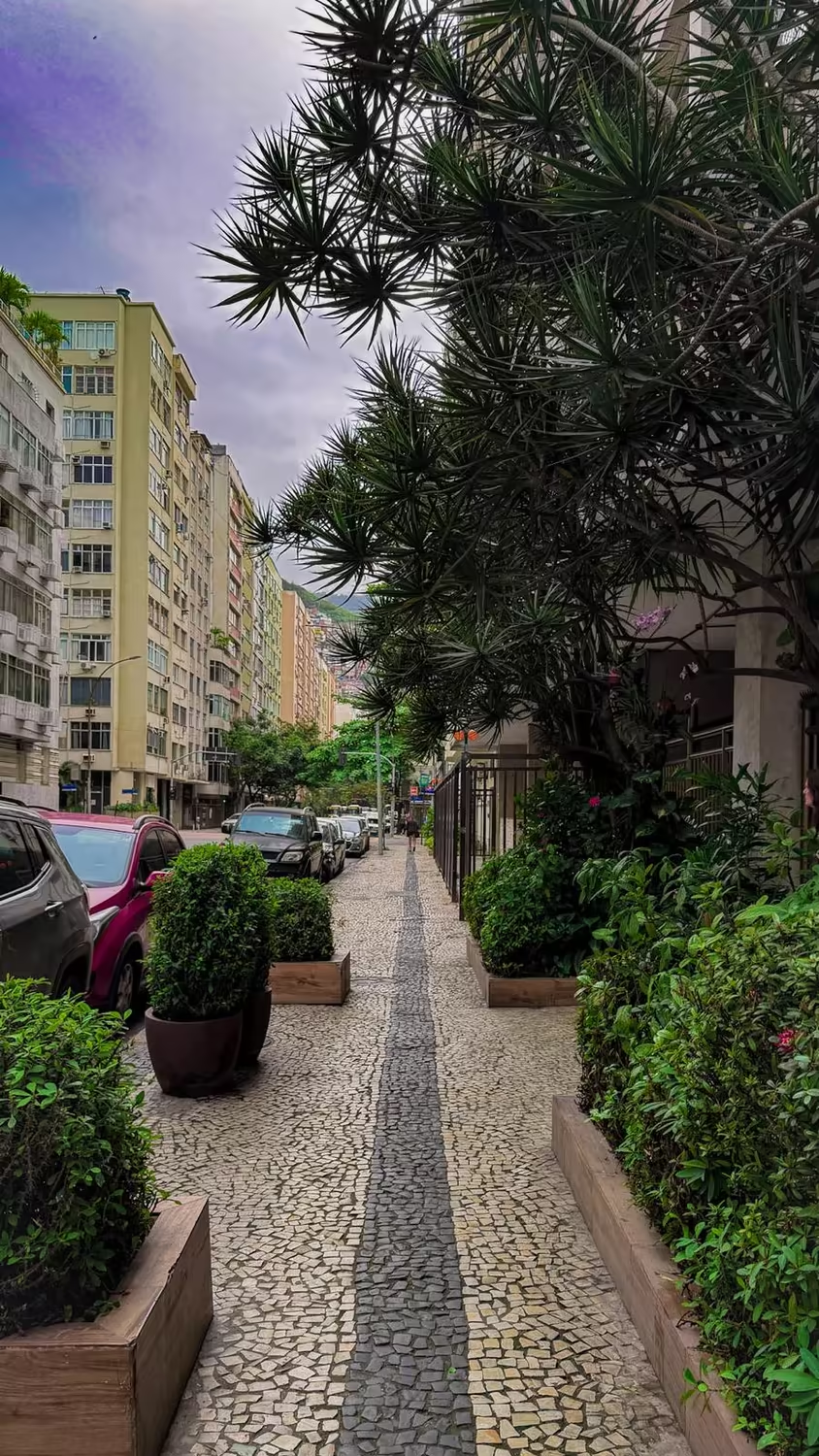
We loved it here. Ipanema is a grid of leafy streets about five blocks deep, with the beach on one side and the Lagoa, the city's big lagoon, on the other, and everything you need is within a ten-minute walk, from cafés and supermarkets to gyms and the metro. It's busy without being frantic and well-heeled without being stuffy, and it felt like a real neighbourhood that people live in rather than a resort. It's also where we heard the most English.
Pros
- Walkable, with the beach and the lagoon on your doorstep
- The best café scene we found in the city
- Two metro stations, General Osório and Nossa Senhora da Paz
- Where we heard the most English
Cons
- One of the most expensive areas to rent
- Busy at weekends, when half the city comes to the beach
Rent guide: one-bed long lets from about R$5,000 to R$5,500 a month, and far more for a furnished short let
Work from: SO_Lo Café or Aussie Coffee, or Spaces Ipanema for a desk
Leblon
Upmarket and quieter
Right next door to Ipanema and separated from it only by a canal, Leblon was the one other neighbourhood we spent proper time in. It's Rio's most expensive postcode and feels a touch calmer and more residential than its neighbour, with more families and fewer tourists, and Rua Dias Ferreira has a superb run of restaurants and bars. The beach is the same stretch of sand, just a little quieter. If budget isn't a concern and you want Ipanema with the volume turned down, this is it.
Pros
- Quieter and more residential than Ipanema
- Excellent restaurants and bars
- Arguably the most comfortable part of the Zona Sul
- On metro Line 4
Cons
- The priciest neighbourhood in the city
- Fewer cafés to work from
Rent guide: one-bed long lets from about R$5,300 to R$5,800 a month
Work from: SO_Lo's Leblon branch on Avenida Ataulfo de Paiva
Copacabana
Busy and better value
We never made it to Copacabana. It's the famous one, four kilometres of beach backed by a wall of hotels and apartment blocks, and a much denser and more chaotic neighbourhood than Ipanema. Accommodation is noticeably cheaper and there's a huge amount of it, which is why plenty of nomads end up here. The trade-off, by all accounts, is more tourists and more petty crime, particularly along the beachfront at night.
Pros
- Cheaper, with far more accommodation to choose from
- Three metro stations and everything on your doorstep
Cons
- Hectic and very touristy
- More hassle and petty theft than Ipanema or Leblon
Rent guide: one-bed long lets from about R$3,300 to R$3,700 a month
Work from: home, or Spaces Ipanema a short metro ride away
Botafogo
Local and creative
A step inland, Botafogo is the neighbourhood that comes up most often as the "real Rio" alternative. It has no beach you'd want to swim at, but rents are well below the beachfront neighbourhoods and the bar and restaurant scene is thriving, with a local crowd. It also has one of the best views of Sugarloaf going. If we came back for a couple of months and wanted to spend less, this is where we'd start looking.
Pros
- Much better value than the beach neighbourhoods
- Great food and nightlife with a local crowd
- Central and well connected
- Coworking close by
Cons
- No beach for swimming
- Busier roads and less polish
Rent guide: one-bed long lets from about R$3,300 to R$3,700 a month
Work from: Spaces in the Edifício Mourisco, or Regus Botafogo
Santa Teresa
Bohemian and hilly
The arty hilltop neighbourhood above the city centre is all crumbling colonial mansions and winding cobbled streets, with a rattling yellow tram. It looks gorgeous and it's a completely different Rio from the beach strip. It's also steep and borders several favelas, so you'll rely on Uber to get around and want to be more careful after dark. It's a lovely day trip and a more niche choice as a base.
Pros
- Bags of character and some great views
- Cheaper, with some beautiful old guesthouses
Cons
- Hilly and isolated, so you'll need Uber for everything
- Needs more care at night
Rent guides are our estimates from FipeZap asking rents per square metre for September and October 2026, applied to a one-bedroom flat of around 45m². Furnished short lets usually cost far more.
Where to work
We've gone off coworking spaces in recent months, so on this trip we worked from the cafés of Ipanema and our apartment. Rio has proper coworking if you want it, but day passes cost more than you might expect, and Spaces in Ipanema is the only big-name option in the beach neighbourhoods.
Cafés
SO_Lo Café
Ipanema, with branches in Leblon and Copacabana · Our pick · Rua Garcia d'Ávila 147, Ipanema
Our regular, and the place we worked from most. The name stands for Sustentável, Orgânico, Local, and the menu follows through with excellent brunch and proper sourdough, along with very good coffee. The Wi-Fi was solid and the staff never once made us feel we were outstaying our welcome. If you'd rather people-watch than work, there's outdoor seating too.
Aussie Coffee
Ipanema · Rua Visconde de Pirajá 98, near General Osório
Hugely popular with nomads, to the point where at busy times it's basically a coworking space that happens to serve flat whites. It's hidden down a long corridor, so you'll probably walk past it at least once. Good coffee and fast Wi-Fi with plug sockets make it a natural office, but it's small and seats go quickly, so get there early. Other than the name, there was nothing remotely Australian about the place that we could see.
Nusa Café
Ipanema and Leblon · Rua Vinicius de Moraes 129, Ipanema
A really cool brunch spot that we liked a lot, but it isn't somewhere you'd work from. Go for the food and a coffee, and leave the laptop in your bag.
Coworking
Spaces
Ipanema and Botafogo · Day passes from R$189
The polished international chain is the only big-name operator in Ipanema itself, on Rua Visconde de Pirajá. There's a second Spaces in Botafogo, in the Edifício Mourisco on Praia de Botafogo, which is handy if you're living inland.
WeWork
Centro and Barra da Tijuca · Day passes from R$214 plus taxes
None of WeWork's Rio spaces is in the beach neighbourhoods. The closest to the Zona Sul is at Bossa Nova Mall, next to Santos Dumont airport, so it only really makes sense if you already have a membership.
For somewhere free, try the library at A Maison, in the Casa Europa building in the city centre, which also houses the French consulate. Registration is free, but opening hours are limited, so check before you make the trip.
Internet and SIM cards
Brazil has good fibre, and most decent apartments in the Zona Sul will get you 100Mbps or more. Fibre connections in Rio averaged 195Mbps in October 2026, but as always, ask your host for a screenshot of a speed test rather than trusting the listing.
For mobile data, Claro's Prezão prepaid plan gives you 17GB for 30 days for R$30, with unlimited WhatsApp and calls within Brazil. If you'd rather sort it out before you land, Vivo's Tourist Plan is an eSIM with 25GB for 30 days for R$55, bought with your passport and an international card, and Claro sells a Flex Pass tourist eSIM that doesn't need a Brazilian ID number. Whether a shop will register an ordinary prepaid SIM with just a passport varies, so the tourist eSIMs are the safer bet.
Food & drink
Brazilian food is generous and built for sharing, and Rio adds a beach culture all of its own, where half your daily intake arrives via someone walking past your towel with a cool box. You will not go hungry here.
What to eat
- Feijoada: The national dish, a slow-cooked stew of black beans and various cuts of pork, served with rice, greens, orange slices and farofa, which is toasted cassava flour. It's traditionally a Saturday lunch, best followed by doing absolutely nothing.
- Churrasco: Brazilian barbecue. At a rodízio, the waiters circulate with skewers of meat and carve it at your table until you beg them to stop. We had ours as part of a full-day tour of the city's big sights, and a few platefuls left us immobile.
- Pão de queijo: Small, chewy cheese breads made with cassava flour. They're gluten-free by accident and dangerously easy to eat by the half-dozen with a coffee, and they were among our favourite things in Rio.
- Açaí: Frozen and blended, then served in a bowl with granola and banana. In Rio it's a post-beach staple rather than the pricey health food it has become elsewhere.
- Coxinha and pastel: The snack counter classics. Coxinha is shredded chicken wrapped in dough and deep-fried in a teardrop shape, while pastel is a thin, crisp fried pastry with all sorts of fillings.
- Moqueca: A fragrant fish or prawn stew made with coconut milk and peppers. It's from further up the coast, but you'll find very good versions here.
- Caipirinha and chopp: The caipirinha is the national cocktail, made with cachaça, lime, sugar and ice, and served strong. On the beach the default order is a chopp, an ice-cold draught lager in a small glass, so it never gets the chance to warm up.
On the beach
Eating and drinking on the sand is a Rio institution. Rent a chair and an umbrella from one of the barracas, which will run you a tab, then wait for the vendors to come to you with grilled cheese on a stick, iced mate tea poured from a metal drum, bags of Biscoito Globo and caipirinhas. Plenty of vendors carry card machines, but check the amount on the screen before you tap.
Where to eat and drink
Between work and our café habit, we didn't do Rio's restaurant scene justice, so these are well-regarded names on our list for next time rather than personal recommendations.
- Zazá Bistrô Tropical: A colourful, long-standing Ipanema favourite in an old house on Rua Joana Angélica, a block from the beach, serving Brazilian food with plenty of other influences thrown in.
- Jobi: A classic Leblon boteco, or neighbourhood bar, on Avenida Ataulfo de Paiva that has been pouring chopp since 1956. Go for the beer and the bar snacks.
- Braseiro da Gávea: A no-frills institution on Praça Santos Dumont, just inland from Leblon, known for its grilled picanha and permanently packed.
- Bar Urca: Open since 1939 at the foot of Sugarloaf. Order beers and pastéis from the counter and eat them on the sea wall opposite with the rest of the neighbourhood.
- Confeitaria Colombo: A grand belle époque café in the city centre, open since 1894 and all mirrors and stained glass.
- Oteque and Lasai: For the top end of Brazilian cooking, Oteque in Botafogo holds a Michelin star and Lasai holds two. Lasai is closed while it moves to the Sofitel in Ipanema, where it's due to reopen from December 2026.
Off the clock
Things to see and do
Work commitments meant we spent a lot of time hiding in our Airbnb like Gollum in his cave, and we saw far less of Rio than we wanted to. We did the two big ones, both of which are worth every bit of the hype, and the rest of this list is what's waiting for us next time. Try to do Christ the Redeemer and Sugarloaf early in your stay, so you've got time to go back if the clouds roll in.
Sugarloaf Mountain
Our pick for sunset
This was great. Two cable cars take you up in stages, first to Morro da Urca at 220 metres and then on to the 396-metre summit of Sugarloaf itself, and the views back over the bay to Christ the Redeemer are ridiculous. The cable car has been running since 1912. Go late in the afternoon and stay for sunset, with a caipirinha at the Clássico bar up on the mountain, which is a very cool spot for a sundowner.
From R$205 · Daily from 8.30am (7.30am at weekends) to 9pm
Christ the Redeemer (Cristo Redentor)
Go on the first train
The obvious one, and yes, you have to. The statue stands 30 metres tall on an eight-metre pedestal at the top of Corcovado, 710 metres above the city, and it has been there since 1931. The classic way up is the little cog train from Cosme Velho, which climbs through the Tijuca forest every 20 minutes. Our main piece of advice is to go on the very first train. Even at opening time it's packed, and by mid-morning the platform at the top is a sea of people lying on the floor trying to get the angle for their photo. If budget allows, a helicopter flight is a more impressive way to see the statue, with Sugarloaf and the coastline thrown in and nobody's selfie stick in your face, though expect to pay from around R$1,000 to R$1,800 per person.
Train R$134 return, including entry · Daily, 8am to 6pm
Sunset at Arpoador
The rocky headland between Ipanema and Copacabana is where half the neighbourhood gathers every evening to watch the sun go down and, in true Rio fashion, give it a round of applause.
Free · A ten-minute walk from most of Ipanema
Jardim Botânico
Rio's botanical garden was founded in 1808 and is famous for its avenue of towering royal palms. It sits at the foot of Corcovado on the far side of the Lagoa, and it makes a calm, green antidote to the beach.
R$80 for foreign visitors · Thursday to Tuesday 8am to 5pm, Wednesday 11am to 5pm
Escadaria Selarón and Santa Teresa
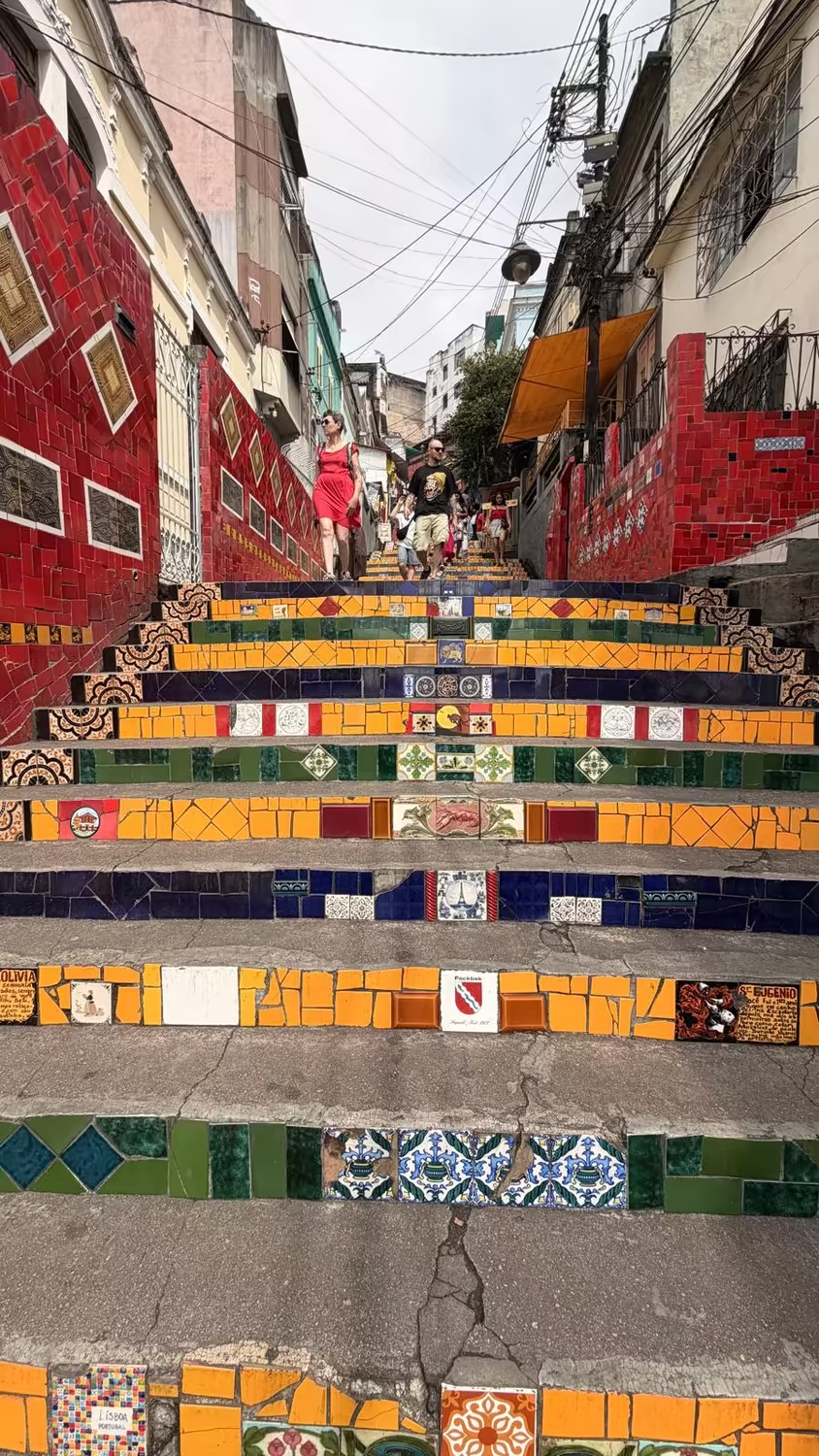
The famous tiled staircase links Lapa with Santa Teresa, its 215 steps covered in thousands of brightly coloured tiles by the Chilean artist Jorge Selarón. It gets busy, so go early if you want a photo without the crowds, then carry on up for a wander around Santa Teresa while it's still light. Fun fact: part of the video for Snoop Dogg's "Beautiful", featuring Pharrell, was filmed on the steps.
Free · Best in daylight
Museu do Amanhã
The Museum of Tomorrow is a science museum in a spectacular Santiago Calatrava building on the regenerated waterfront in the city centre. Save it for a weekday off.
R$40, or R$10 on the 10th of each month · Thursday to Tuesday, 10am to 6pm
Dois Irmãos
The twin peaks tower over the end of Leblon beach, and the view from the top, straight down the length of Leblon and Ipanema, is the one you've seen in every photo of Rio. The trail starts at the top of Vidigal, a favela, and both the UK and US governments advise against entering favelas, so weigh that up and only go with a reputable local guide.
About 1.5km and an hour up from Vidigal · Go with a guide
Keeping fit
Rio might be the easiest city we've ever visited for staying active, because everybody else is at it too. At six in the morning the beachfront is already full of runners and people doing pull-ups, and it's hard to sit there with a pastry and not feel judged.
The beachfront, Leblon to Arpoador
Run · Cycle
Almost four kilometres of flat, wide promenade from the far end of Leblon to the rocks at Arpoador, with the sea on one side and a segregated cycle lane alongside, so you're not dodging bikes. Carry on around the headland and down Copacabana if you want to make it a long one.
Lagoa Rodrigo de Freitas
Run · Cycle
The path around the lagoon behind Ipanema is a pancake-flat loop of about 7.5km, with Christ the Redeemer looking down at you for most of it. Link it with the beachfront from Ipanema for a very scenic 15km or so.
Sundays on the seafront
Run · Cycle
On Sundays and public holidays, the beach-side carriageway from Leblon to Copacabana closes to cars from 7am to 6pm, or 7pm in summer, and fills with runners, cyclists, skaters and families. It's the best day of the week for a long run.
Tijuca National Park
Walk
This is a city with a rainforest in the middle of it, and the park has trails for every level. Pedra Bonita is an easy climb to the spot where the hang-gliders launch, while Pedra da Gávea is long and hard, with a short scramble. Go with a guide and start early, taking more water than you think you'll need.
Whatever the day, go early or late, and leave your phone at home or strap it somewhere out of sight.
On the beach
The sand is a sports facility in its own right. There are free outdoor gym stations with pull-up and dip bars every few hundred metres, along with permanent nets for beach volleyball and futevôlei, which is volleyball played with your feet and which the locals make look insultingly easy. There are surf schools at Arpoador if you want lessons, and stand-up paddleboards for hire at the calmer end of Copacabana.
Gyms and everything else
Brazilians take the gym seriously. Smart Fit is the budget chain, with a no-contract plan from R$119.90 a month, though prices vary by branch, while Bodytech is the upmarket option, with more than 30 gyms in Rio state. Beyond that there's yoga and pilates on practically every corner, along with Brazilian jiu-jitsu, this being the city that made it famous.
People and community
Rio has a big expat community, though organised nomad meetups are smaller than in some Latin American hubs. InterNations has around 16,000 members in the city and runs regular events, and there are active WhatsApp groups for everything from pub meetups to hiking, while the Gringos in Rio de Janeiro group on Facebook is a good place to ask for advice.
Portuguese is the language of daily life, and after two years in Spanish-speaking countries we found it a strange adjustment. The two languages are just similar enough to lull you into a false sense of security, right up until a waiter says something at full speed and you realise you understood next to nothing. Thankfully, English was far more widely spoken than we expected, at least in Ipanema and Leblon, so we were never stuck.
If you're staying a while, lessons make a big difference. Caminhos, on Rua Farme de Amoedo in Ipanema, and Rio & Learn, on Rua Siqueira Campos in Copacabana, both teach Portuguese to foreigners.
Tips
Positives
Ipanema is a brilliant base.
Its leafy, walkable streets sit between the beach and the lagoon.
Staying active is easy.
With the promenade and the lagoon loop on your doorstep, it's hard to skip a workout.
The café scene is excellent.
SO_Lo and Aussie Coffee make working without a coworking membership easy.
The views are unforgettable.
Christ the Redeemer and Sugarloaf both live up to the hype, especially on a clear day.
The nomad visa is easy to qualify for.
US$1,500 a month in income or US$18,000 in savings will do it.
The time zone suits the Americas.
Rio is only one or two hours ahead of New York all year.
Negatives
You'll need to stay alert.
Phone theft is common, and the caution you need takes some of the shine off wandering about.
Ipanema and Leblon are expensive.
They're among the priciest places to rent in Brazil, and short lets cost far more.
It's a megacity.
With more than six million people, you'll rely on Uber and the metro to see much beyond the Zona Sul.
Portuguese can catch you out.
Spanish only gets you so far, so a few lessons go a long way.
Summer is sticky and expensive.
From December to March it's hot and humid, and prices peak over New Year and Carnaval.
Tips
Book a month, not two weeks.
Two weeks was nowhere near enough for us.
Come between May and September.
You'll get mid-twenties sunshine and lower prices than in summer.
Keep your phone out of sight.
Step into a shop or café to check a map or order an Uber.
Take Ubers after dark.
They're cheap, even for journeys you'd walk in most cities.
Catch the first train up Corcovado.
By mid-morning the viewing platform is packed.
Save Sugarloaf for sunset.
Go up late in the afternoon and stay for a drink as the lights come on.
Get a tourist eSIM.
Vivo and Claro both sell tourist eSIMs that skip the paperwork of a local SIM.
Check the card machine.
Look at the amount on the screen before you tap, especially with beach vendors.
Apply for your e-visa early.
US, Canadian and Australian citizens need one before they travel.
Rio de Janeiro · Overall 7/10
Work setup 8 · Walkability 7 · Value 6 · Safety 5 · Lifestyle 9 · Stayed two weeks, August 2026
Working from Rio de Janeiro?
Nomad Register counts your days in Brazil against the 90-day visitor limit and turns your trip into a request your employer can approve in a click, across 200+ destinations.
Log your Brazil trip · For employers
Need sign-off first? Create a free remote work request.
Frequently asked questions
Is Rio de Janeiro good for digital nomads?
Yes, if you base yourself in the Zona Sul and take sensible precautions. Ipanema has an excellent café scene and fast fibre with the beach on your doorstep. The main drawbacks are high rents and the need to stay alert to theft.
Where should digital nomads stay in Rio de Janeiro?
Ipanema is the best all-round base, with the best cafés and a walkable grid of streets between the beach and the lagoon. Leblon next door is quieter and pricier. For lower rents, look at Botafogo or Copacabana.
How long can I stay in Brazil as a tourist?
British and most EU citizens can stay visa-free for up to 90 days, and the Polícia Federal can extend that for some passports, up to 180 days a year. Nationals of many Schengen countries are limited to 90 days in any 180. US, Canadian and Australian citizens need an e-visa, which allows stays of up to 90 days at a time.
Does Brazil have a digital nomad visa?
Yes. The VITEM XIV lets remote workers with foreign income of at least US$1,500 a month, or US$18,000 in savings, live in Brazil for up to two years. Our Brazil digital nomad visa guide covers the requirements.
How much does it cost to live in Rio de Janeiro as a digital nomad?
Budget around R$5,000 a month before rent to live comfortably in Ipanema, plus roughly R$5,000 to R$5,500 for a one-bedroom long let there. Short lets cost far more, and our one-bedroom Airbnb in Ipanema came to about R$11,700 a month.
Is Rio de Janeiro safe for digital nomads?
Ipanema and Leblon never felt threatening to us, but opportunistic theft is common, with phones the main target. Keep your phone out of sight on the street and take Ubers at night.
When is the best time to visit Rio de Janeiro?
May to September, with August our pick. It's the driest part of the year, with highs in the mid to high twenties and lower prices than in summer, when it's hot and humid and prices peak around New Year and Carnaval.
How fast is the internet in Rio de Janeiro?
Fibre is widespread, and most decent apartments in the Zona Sul get 100Mbps or more. Prepaid mobile data is cheap, with Claro's Prezão plan giving you 17GB for 30 days for R$30.
What time zone is Rio de Janeiro in?
Rio uses Brasília time (UTC−3) all year, with no daylight saving. It's three hours behind London in the UK winter and four in summer, and one or two hours ahead of New York.
Can you drink the tap water in Rio de Janeiro?
It's treated to drinking standards, but it passes through building tanks before it reaches your tap, so many residents filter it or buy bottled water.
Do I need to speak Portuguese in Rio de Janeiro?
Not in Ipanema and Leblon, where English is more widely spoken than you might expect. Elsewhere, Portuguese makes life much easier, and Spanish only gets you so far.
Is there Uber in Rio de Janeiro?
Yes, and it's cheap and widely used. An Uber from Galeão airport to Ipanema typically costs R$60 to R$100, and it's the easiest way to get around after dark.
Where next
- Panama City: Copa's hub, with a walkable old town and a free stopover on the way to Rio
- Santiago: Chile's capital, with Valparaíso and Easter Island within reach
- Cuenca: Ecuador's colonial highland city, with spring-like weather all year
- Valencia: Spain's sunny third city, with a park through the middle and the beach a bike ride away
- Brazil Digital Nomad Visa guide: requirements, income, tax and how to apply
- All city guides
About this guide
James is the founder of Nomad Register and has been a full-time digital nomad for around two years. He spent two weeks in Ipanema in August 2026, arriving from Panama City on the Copa stopover and working from cafés and his apartment. This guide is based on that visit, with facts and prices checked in November 2026. You can read his original trip report on The Nest.
This guide is for general information only and is not legal or tax advice. Visa rules and prices change, so confirm entry requirements with the Brazilian authorities or your government's travel advice before you travel.